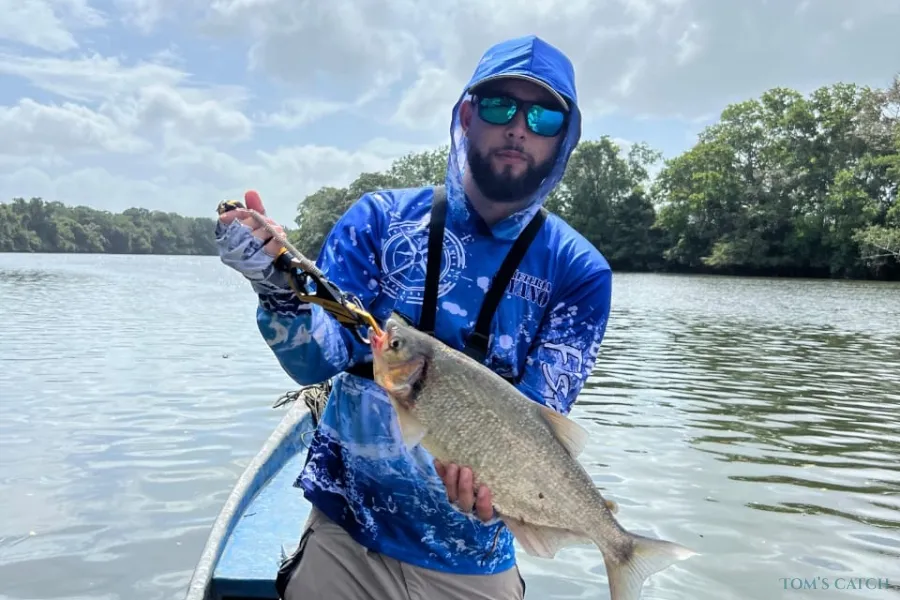
Ruby Snapper fishing
The Ruby Snapper (Etelis carbunculus) is a deep-water species found across the Indo-Pacific, recognized by its elongated body, large eyes, and vivid red-pink coloration. Living at depths of 90–400 m over rocky reefs, it forms aggregations and preys on fish, squid, and crustaceans. With long pectoral fins and a forked tail, it’s a prized catch for its beauty and strength, typically reaching around 65 cm in length.
Top Ruby Snapper Fishing destinations
The Ruby Snapper inhabits deep rocky reefs and steep underwater slopes throughout the Indo-Pacific Ocean. Found at depths of 90–400 meters, it prefers rugged substrates where it can hunt and form loose aggregations. Its wide distribution stretches from the Red Sea and East Africa across the Indian Ocean to Japan, Australia, and the islands of the central Pacific, including Hawaii. This broad range makes it one of the region’s most widespread deep-reef predators.

How to fish for Ruby Snapper
The best way to catch Ruby Snapper (Etelis carbunculus) in sport fishing is deep-water bottom fishing over rocky reefs and steep slopes. They are usually found at depths between 90 and 400 meters, so local knowledge or a professional guide can help locate productive areas. Medium-heavy to heavy rods with strong saltwater reels are recommended, along with braided line of 30–50 lb and a fluorocarbon leader to reduce visibility.
Fresh squid, small fish like sardines or mackerel, and shrimp work well as natural bait, while heavy jigs or metal lures are effective for vertical jigging. The typical approach is to drop baited hooks to the bottom and slowly lift them to entice strikes, or use lift-and-fall motions with jigs, as Ruby Snapper are aggressive predators. Fishing in areas with structure, such as rocks, ledges, and reef edges, increases the chances of success. Patience is key—once a school is located, the action can be fast, and strong hooks and leaders are essential because these fish fight hard and have sharp teeth.
Good to eat Ruby Snapper
Ruby Snapper is considered excellent to eat. Its flesh is firm, white, and mild-flavored, making it versatile for a variety of cooking methods such as grilling, baking, steaming, or pan-searing. Because it’s a deep-water species, the meat is often dense and less oily than some reef fish, which makes it especially prized in many Indo-Pacific cuisines.
For the best taste, it’s recommended to consume it fresh and avoid overcooking, as the firm texture can become dry if cooked too long. It’s also popular in sushi and sashimi preparations in regions where it’s commonly caught.
Other Fish Species similar to Ruby Snapper
-
![]()
The great barracuda (Sphyraena barracuda), often referred to as barracuda, is a long predator that can be found in tropical and subtropical waters where they like to patroll mangroves, reefs and drop-offs. Record barracuda can grow to 1,5m and weigh over 45kg (100lb+).
MORE INFO >Barracuda
-
![]()
Distributed throughout the tropical waters of the Indo-Pacific region, the Giant Trevally - also known as GT - (Caranx ignobilis) is the most wanted species for popping lovers. They can be 1,70 cm long and reach up to 80 kg (175 lb)!
MORE INFO >Giant Trevally
-
![]()
The pink dentex (Dentex gibbosus) is a saltwater fish distributed from Portugal to Angola, Canary Islands and the warmer areas of the Mediterranean Sea such as southern Spain and the Gibraltar Strait area, Morocco, southern Italy, Tunisia and Algeria. The larger fish are 1,2 m long and can weigh up to 18 kg (40 lb).
MORE INFO >Pink Dentex
-
![]()
The northern red snapper (Lutjanus campechanus) is a popular fish often caught reef fishing in the Atlantic waters of Florida, Gulf of Mexico and also the Caribbean. This sought-after game fish can reach 1 m and weight up to 50lb.
MORE INFO >Red Snapper


![]() Best Ruby Snapper Fishing Charters
Best Ruby Snapper Fishing Charters