King Mackerel vs Spanish Mackerel, all you need to know
Updated: July 2026 · Reviewed by the Tom’s Catch angling team
You’re standing at the cleaning table with a long, silvery fish on the board and a game warden 30 feet away. Is it a Spanish mackerel you can keep at 12 inches, or a small king that needs to hit 24 before it goes in the cooler? Get it wrong and it can cost you a fine. The good news: once you know where to look, you can tell a king mackerel from a Spanish mackerel in about two seconds, right there at the boat.
The short version, if you’re in a hurry: flip up the front (first) dorsal fin. A black blotch on it means Spanish mackerel. No spot, and a lateral line that drops sharply below the second dorsal fin, means king mackerel. Spanish stay small (usually under 20 in) and wear pale yellow-gold spots; kings run big (3–5 ft) and are mostly plain silver. Below we break down every tell, the legal sizes and bag limits you actually need, and which one is better on the plate.
King Mackerel vs Spanish Mackerel: quick comparison
Here’s everything side by side. Regulations shown are Florida (FWC) recreational limits, the most-searched benchmark — always check your own state before you keep a fish.
| Feature | King Mackerel (kingfish) | Spanish Mackerel |
|---|---|---|
| First dorsal fin | Uniform gray, no spot | Black blotch on the front — the #1 tell |
| Lateral line | Drops abruptly below the second dorsal fin | Slopes gently and evenly to the tail |
| Body spots | Mostly plain silver (juveniles may show faint spots that fade) | Rows of pale yellow-gold spots on the sides |
| Typical size | 3–5 ft, up to ~72 in and 90+ lb | 1–1.5 ft, usually under 20 in |
| Min. size to keep (FL) | 24″ fork length | 12″ fork length |
| Daily bag limit (FL) | 2/harvester (Atlantic) · 3/harvester (Gulf & Monroe Co.) | 15/harvester |
| On the plate | Stronger, oilier — shines smoked; higher in mercury | Milder, firmer — better fresh; lower in mercury |
How to tell them apart (the 2-second boat-side check)
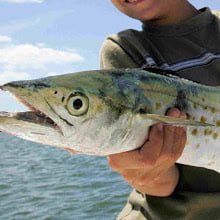
Forget color first — light and water change it. Go straight to these three tells, in order:
- The dorsal-fin spot. Lift the front dorsal fin. If the leading edge is black, it’s a Spanish mackerel. If the whole fin is plain gray, it’s a king. This one tell settles most arguments at the dock — and it’s exactly the fish young kings get mistaken for, because juvenile kings can show spots but never that black fin.
- The lateral line. Run your eye down the line along the flank. On a king it takes a hard, obvious dip below the second dorsal fin. On a Spanish it curves down smoothly and evenly, no sharp step.
- Size and spots. A plain silver torpedo over 2 ft is almost always a king. A smaller fish peppered with yellow-gold spots is a Spanish. Careful, though — a small king and a big Spanish overlap in size, which is exactly why the fin spot beats the tape measure.
Watch out for the cero mackerel. Common off South Florida and the Keys, it also has spots but adds a bronze/yellow stripe down the side. Quick tie-breaker: the cero has scales running onto its pectoral fin; king and Spanish do not.
King Mackerel
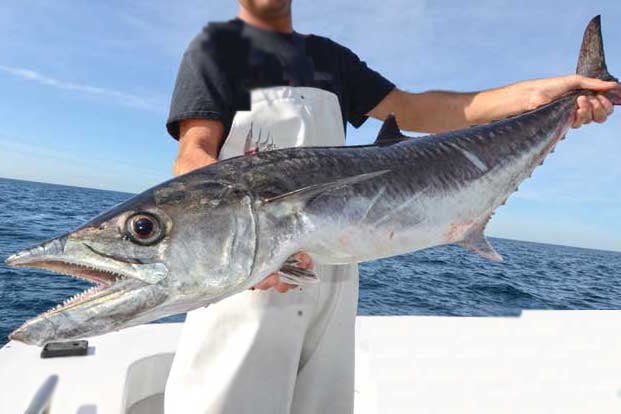
King mackerel — “kingfish” to most anglers — are the bruisers of the group: aggressive gamefish that hammer a slow-trolled bait and peel line on that first run. They average 3–4 ft but genuinely reach around 72 inches and well over 90 lb, so a good king is the fish that makes your reel scream. The back is a silvery, olive-blue; the flanks flash with a rosy iridescence in the sun. There’s no black on the first dorsal fin, and the body is mostly clean silver.
The Lateral line of the King Mackerel
The single most reliable mark on a king is the lateral line: it runs level along the upper body and then takes a sharp, abrupt drop at mid-body, right below the second dorsal fin. On a Spanish (and a cero) that line only curves down gently. If you see a hard step in the line, you’re holding a king — even before you check the fin.
Spanish Mackerel
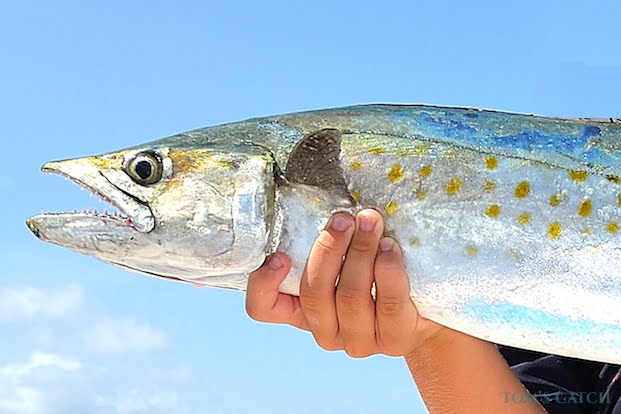
Spanish mackerel are the smaller, more numerous cousin, caught up and down the eastern seaboard and all around the Gulf, often close to the beach and the jetties. They usually run 1–1.5 ft and top out around 20 inches. The giveaways are the rows of pale yellow-gold spots along the sides and — the clincher — the dark, often solid-black front dorsal fin. They school in numbers, hit small shiny lures and live bait, and are a blast on light tackle, which makes them a perfect target for a first-timer or for kids on board.
Regulations & size limits: which one you can actually keep
This is where misidentifying the two fish gets expensive. The rules below are Florida (FWC) recreational limits, current for 2026 — the most-searched baseline. Other states differ, so treat this as your starting point, not gospel for every coast.
- Spanish mackerel: 12″ fork length minimum, 15 per harvester per day, open year-round (Atlantic and Gulf state waters).
- King mackerel: 24″ fork length minimum, open year-round. Bag limit is 2 per harvester in Atlantic state waters and 3 per harvester in Gulf state waters and Monroe County.
- Texas: the king mackerel minimum is 27 inches — higher than Florida.
Why it matters: a 14-inch fish is a legal, in-the-cooler Spanish mackerel — but if it’s actually a small king, it’s 10 inches short of legal and a citation waiting to happen. When there’s any doubt, the black dorsal spot is your best friend. Regulations also change mid-season, so pull up your state’s page before you keep anything close to the line.
Taste & cooking: which mackerel eats better?
Both are good eating fresh, but they’re not the same fish on the plate.
- Spanish mackerel is the milder, firmer of the two and the better fresh choice — grilled, pan-seared or blackened the same day. It’s also lower in mercury, so it’s the safer regular meal for kids and expecting moms.
- King mackerel is stronger, oilier and darker-fleshed. Fresh it divides opinion, but smoked it’s excellent — smoked kingfish dip is a Florida classic. One honest heads-up: king mackerel runs high in mercury, and health agencies list larger kings among the fish to eat sparingly, so keep big kings for the occasional smoke rather than a weekly dinner.
Either way, bleed and ice your catch the moment it’s aboard — with oily fish like these, that’s the difference between a great fillet and a fishy one.
Other Types of Mackerel
Kings and Spanish get the headlines, but you’ll cross paths with a few relatives:
- Cero mackerel — spots and a bronze/yellow side stripe; South Florida and the Caribbean.
- Atlantic mackerel — cooler northern waters, wavy dark bars across the back.
- Sierra mackerel — the Pacific/Latin-American cousin of the Spanish, spotted and prized for ceviche.
- Wahoo — the giant of the family: blistering speed, tiger-striped flanks, and superb on the plate.
Final Thoughts
Kings and Spanish mackerel make for an exciting catch at every experience level — screaming runs from the big kings, fast light-tackle action from the schooling Spanish. Nail the ID (black dorsal spot = Spanish; sharp lateral-line drop = king), respect the size and bag limits for your state, and you’ll keep the right fish, cook it the right way, and stay on the right side of the warden. Enjoy fish comparisons? See our marlin vs sailfish and cod vs haddock guides too.
Ready to put it into practice? Both species are bread-and-butter targets for inshore and nearshore charters across Florida and the Gulf, where a local skipper knows exactly what’s biting and where. Browse and book a Florida fishing charter on Tom’s Catch — verified reviews, clear prices, and a captain who’ll help you land (and identify) your next mackerel. Tight lines.
King Mackerel vs Spanish Mackerel FAQs
What’s the easiest way to tell a king mackerel from a Spanish mackerel?
Look at the front dorsal fin. A black blotch on it means Spanish mackerel; a plain gray fin with no spot means king mackerel. As a second check, a king’s lateral line drops sharply below the second dorsal fin, while a Spanish mackerel’s curves gently to the tail.
How big does a king mackerel have to be to keep in Florida?
In Florida, king mackerel must be at least 24 inches fork length. The daily bag limit is 2 per harvester in Atlantic state waters and 3 per harvester in Gulf state waters and Monroe County. Spanish mackerel only need to be 12 inches, with a 15-per-harvester limit.
Do small king mackerel have spots like Spanish mackerel?
Juvenile king mackerel can show faint spots that fade as they grow, which is why size alone fools people. But young kings never have the black front-dorsal-fin blotch of a Spanish mackerel, so the fin spot is the reliable tell.
Which mackerel tastes better?
Spanish mackerel is milder, firmer and better eaten fresh, and it’s lower in mercury. King mackerel is stronger and oilier — best smoked — and larger kings are high in mercury, so eat them sparingly.
Is a Spanish mackerel just a small king mackerel?
No. They’re two different (though related) species. Even at the same length, you can separate them: the black dorsal-fin spot and the gentle lateral line mark the Spanish; no spot and a sharp lateral-line drop mark the king.