Marlin vs. Sailfish: A Close Look at the Billfish Family
By the Tom’s Catch team · Updated July 2026
Picture the moment: your line screams off the reel, and 200 metres out something big and silver clears the water in a spray of spray and sunlight. Marlin or sailfish? For a second you honestly can’t tell — and that one second is the difference between a good story and the right story. Both are billfish, both jump like fireworks, both are on plenty of anglers’ bucket lists. But they fight differently, live in different water, and one of them is a genuinely realistic first billfish while the other can top 1,400 pounds.
In a hurry? Here’s the tell: look at the fin on its back. A sailfish carries a huge, sail-like dorsal that runs almost the length of its body — unmistakable when it lights up alongside the boat. A marlin’s dorsal is short, peaked at the front and low the rest of the way. That single feature settles 95% of arguments on deck. Everything below is the part the quick answer leaves out: how to call it while the fish is still jumping, which one fights harder, and — the bit that actually matters if you want to catch one — where and when each is within reach.
Marlin vs sailfish at a glance
Same family, very different fish. Here’s the honest side-by-side before we get into the detail:
| Feature | Marlin | Sailfish |
|---|---|---|
| Dorsal fin | Short, pointed, peaks at the front then slopes low | Huge “sail” running nearly the full body — the giveaway |
| Body / build | Thick, heavy, wide girth | Slim, streamlined, light |
| Bill | Longer, thicker, rounder spear | Long but slender and thinner |
| Typical size | ~5–16 ft · 100–1,800 lb (varies hugely by species) | ~6–10 ft · 60–200 lb |
| All-tackle record (IGFA) | Atlantic blue: 1,402 lb 2 oz (Brazil, 1992) | Pacific: 221 lb (Ecuador, 1947) |
| Behaviour | Solitary hunter | Schools and herds baitballs together |
| Where it lives | Deep, open blue water | Nearer shore, shallower (roughly 100–300 ft) |
| Realistic to catch? | Yes, but granders are a lifetime pursuit | Very — the most accessible billfish, great as a first |
The Billfish Family
Marlin and sailfish both belong to the billfish clan — fast, predatory, open-ocean fish named for the long, sword-like bill extending from the upper jaw. Marlins and sailfish sit in the same family, Istiophoridae (the “spearfishes”), which is exactly why they look confusingly similar from a distance and why anglers mix them up all the time. They share the bill, the powered-up jumps, the taste for warm water and the reputation as some of the most exhilarating fish you can hook. Where they part ways is in size, silhouette, temperament and the water they call home — and that’s the whole point of this guide.
Is Swordfish a Marlin?
No — and this is the classic mix-up. The swordfish is a billfish too, but it sits in its own separate family, Xiphiidae, on its own branch of the tree. Marlin and sailfish are cousins in Istiophoridae; the swordfish is more of a distant relative. The quick tells: a swordfish has a long, flat, smooth bill (more sword than spear), no pelvic fins, a tall crescent dorsal it can’t fold down, and it hunts far deeper and mostly at night. If it has scales, pelvic fins and a rounded spear, you’re looking at a marlin or a sailfish, not a swordfish.
Types of Marlin
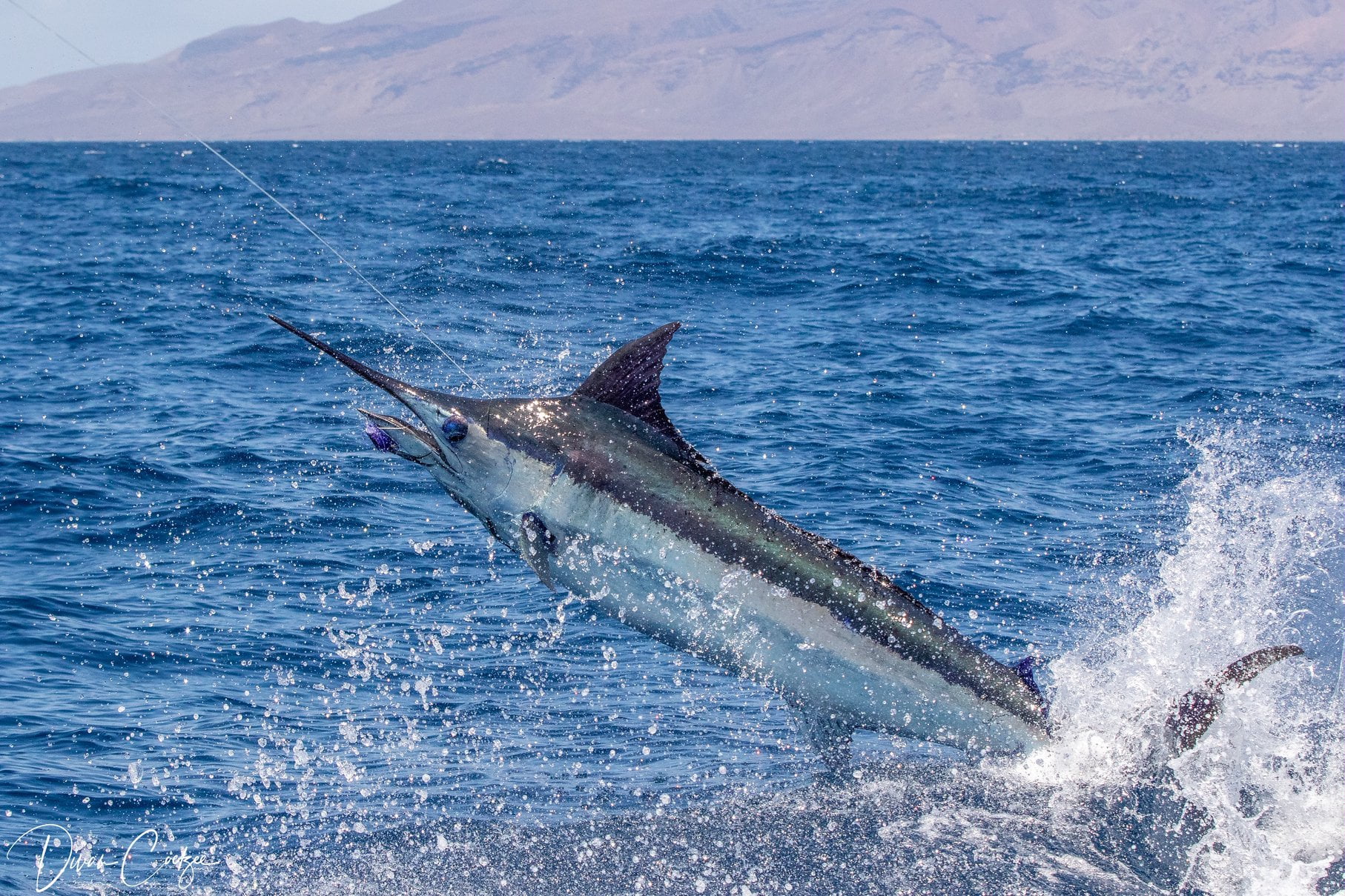
“Marlin” isn’t one fish — it’s several, and knowing which is which changes where you’d go to target it:
- Blue marlin — the giant of the group and the classic grander (1,000 lb+). The Atlantic and Pacific each have their own. This is the one that makes 1,400 lb records.
- Black marlin — heavy-bodied Indo-Pacific brute, famous off Australia’s Great Barrier Reef and often called the fastest of the marlins.
- Striped marlin — leaner, spectacular jumper, marked with vivid cobalt vertical stripes that often stay visible even after the fight. The backbone of the Cabo San Lucas fishery.
- White marlin — the smallest and most agile of the big marlins, prized in the Atlantic for its acrobatic, twisting jumps.
- Spearfish — the rarest and most slender of the clan, sometimes grouped with the marlins.
Types of Sailfish
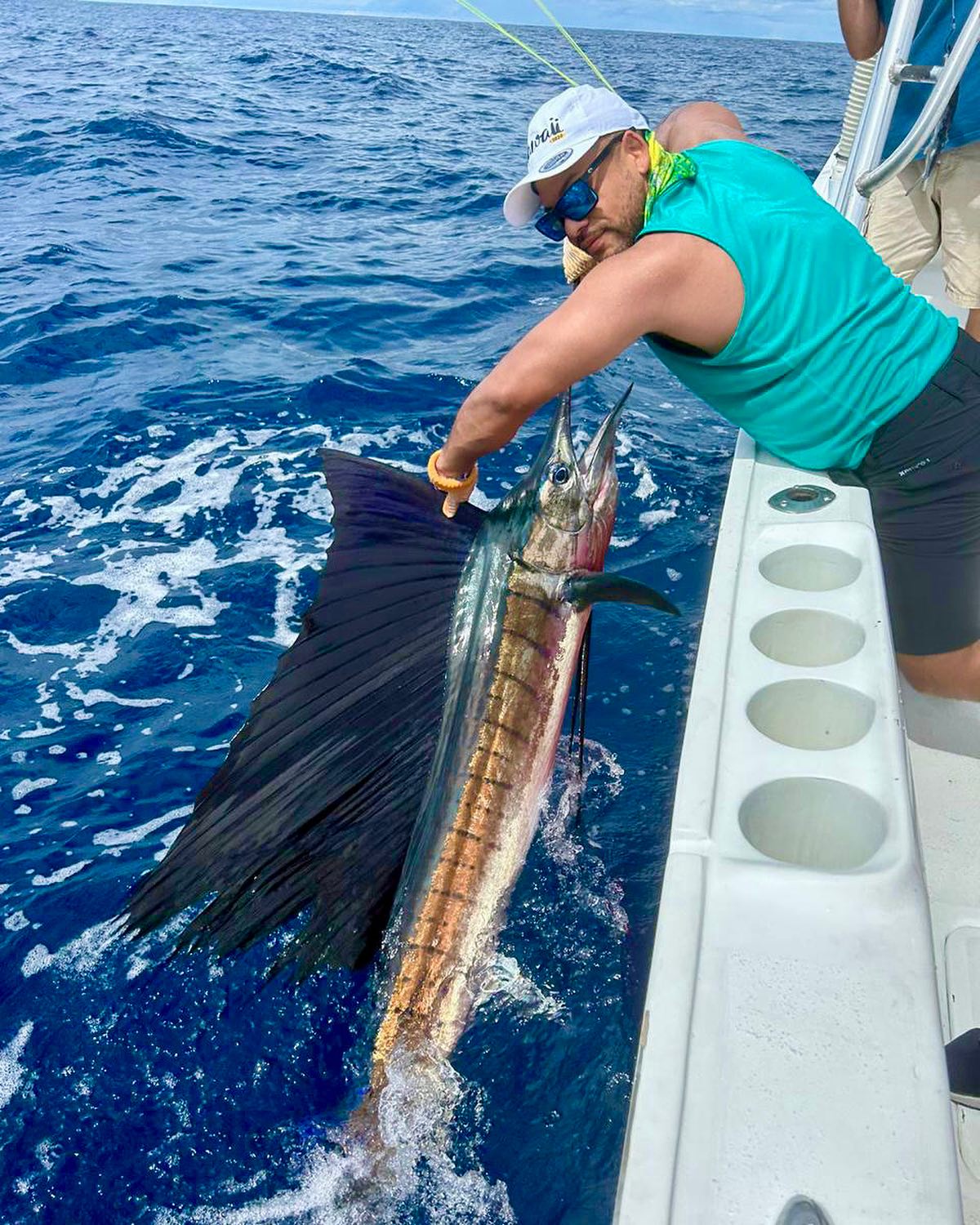
Sailfish are simpler. Anglers traditionally talk about two: the Atlantic sailfish and the (larger) Indo-Pacific sailfish. Most scientists now treat them as a single species, Istiophorus platypterus, split into two populations — so if you hear “there’s only one sailfish,” that’s why. Practically, the Pacific fish run bigger (the 221 lb all-tackle record is Pacific), while Atlantic sails tend to be lighter and faster in the strike.
Appearance
Side by side, three things separate them:
- The sail. The dorsal fin is the headline. On a sailfish it’s enormous — a pleated, accordion-like sail nearly as long as the body, often thrown up when the fish is excited. On a marlin it’s short and pointed, high at the front and sloping down. This alone is your fastest ID.
- The build. Sailfish are slim, torpedo-shaped and light. Marlins are thick through the shoulders with a heavy girth — they simply look denser and more powerful.
- The bill. Both carry the spear, but a marlin’s is longer, thicker and rounder; a sailfish’s is slender by comparison.
- Colour. Both flash iridescent blues, purples and bronze that shift with light and stress. Striped marlin add unmistakable cobalt vertical bars; a lit-up sailfish glows electric blue along the sail.
How to Tell Them Apart on the Hook
Reading a mounted fish in a photo is easy. Calling it while it’s greyhounding across the surface 150 metres out is the real skill — and it’s where local crews earn their keep. Here’s how experienced anglers make the call in the heat of a bite:
- Watch the fin first, not the fish. The instant it clears the water, look for the sail. If a big fan snaps up over the back, it’s a sailfish. If the back looks clean with just a short peak, it’s a marlin.
- Read the jump. Sailfish are lighter and tend to skitter and tail-walk across the surface in fast, frantic bursts. Marlin jumps are heavier and more deliberate — big, powerful clears with real weight behind them. A white marlin is the exception: quick, twisting, agile jumps that can fool you into thinking “sail.”
- Feel the weight through the rod. A sailfish takes drag in fast, nervous runs. A marlin loads the rod with a deep, grinding, unmistakably heavier pull. Your captain often calls the species from the reel before anyone sees the fish.
- Look for the stripes at colour-up. As the fish tires and comes up “lit,” striped marlin show those hard cobalt bars; a sailfish glows along the sail rather than the flank.
Don’t sweat it if you can’t tell at first — that’s exactly what the skipper and mate are for. Half the fun is calling “marlin!” and having the deckhand grin and say “sail.” A good local crew will have it pegged in seconds.
Hunting Techniques
They earn a living in opposite ways. Marlins are loners — they hunt alone in the open blue, using that heavy bill to slash and stun individual prey like tuna, mackerel and squid before circling back to eat. Sailfish are team players. They move and hunt in groups, working together to corral bait into tight balls and then raising their sails to “wall in” and herd panicked schools of sardines and smaller fish. That sail isn’t just for show — it’s a hunting tool. It’s one of the most spectacular predatory displays in the ocean, and it’s exactly why sailfish grounds off Guatemala or Isla Mujeres can go wild with fish on the surface.
Fighting
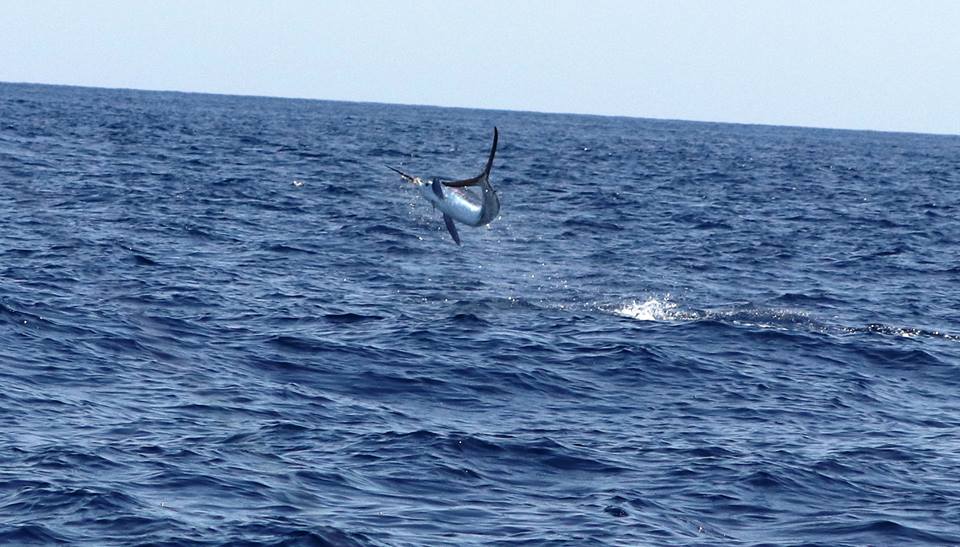
This is the question every angler really asks: which one fights harder? Honest answer — it depends on what you mean by “hard.”
Pound for pound, a sailfish is pure adrenaline: blistering runs, endless tail-walking and acrobatics on lighter tackle, which is why so many anglers fall in love with them. But a marlin is a different order of raw power. Explosive strikes, deep bulldogging runs and heavy leaps — a big blue can test your back, your gear and your patience for hours. A sailfish gives you the show; a big marlin gives you the war. Which is “better” is genuinely a matter of taste, and plenty of anglers chase both for exactly that reason.
About that “fastest fish” claim. You’ll read everywhere that sailfish hit 68 mph, making them the fastest fish in the sea. Worth knowing before you repeat it at the dock: that figure comes from a rough 1940s stopwatch estimate of a hooked, jumping fish. More recent research — muscle-contraction timing and high-speed video (Biology Open, 2016, tellingly titled “a myth revisited”) — puts a sailfish’s realistic top speed far lower, and argues physics (cavitation) caps them well under the old number. They’re still ferociously fast and out-accelerate a marlin in the strike — just take the 68 mph headline with a pinch of sea salt. For the full story, see our fastest fish in the ocean guide.
Habitat and Distribution
Where they live is another clean way to separate them. Marlins are true blue-water fish — they roam deep, open ocean, often well offshore where the bottom drops away, following warm currents and bait across the Atlantic, Pacific, Indian Ocean, the Caribbean and the Gulf of Mexico. Sailfish generally hold nearer shore in shallower water (very roughly 100–300 ft), often close to reefs, drop-offs and bait concentrations — which is part of why they’re more accessible on a normal charter day. Both love warm, tropical and sub-tropical seas, so the map of where you’d fish for each overlaps but is far from identical.
Where and When to Catch Each One
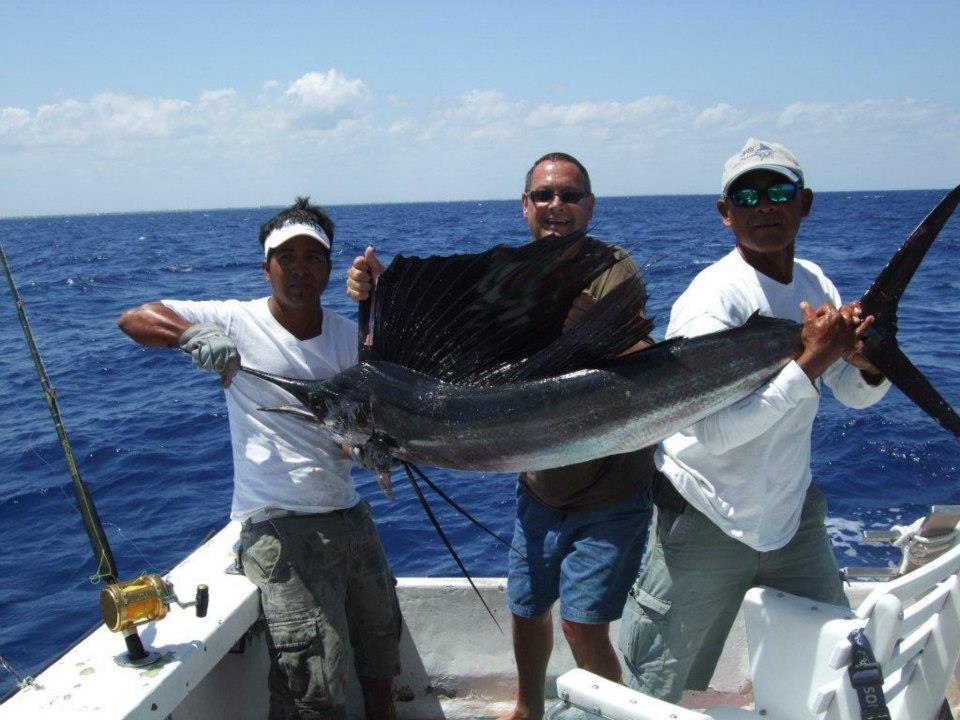
Here’s the part a quick SERP answer never gives you: if you actually want one of these on the end of your line, where and when matter more than anything. Both run on seasons, and the right destination stacks the odds hugely in your favour.
Chasing sailfish (the accessible billfish)
If it’s your first billfish, start here. Sailfish come in numbers, sit closer to shore and are landed on lighter tackle.
- Guatemala — arguably the best sailfish fishery on earth. Boats out of Iztapa and Puerto San José regularly release double-digit numbers in a day. Peak roughly December–May.
- Costa Rica — Quepos and Los Sueños on the Pacific side deliver spectacular runs, best around December–April.
- Isla Mujeres, Mexico — the famous winter sailfish run (roughly January–March), when packs of sails ball sardines right at the surface.
Chasing marlin (the bucket-list beast)
Marlin ask more of you — more offshore, heavier tackle, bigger patience — but the payoff is a fish of a lifetime.
- Cabo San Lucas, Mexico — striped marlin all around the calendar with a cooler-months peak, plus blue and black marlin in the warm season.
- Kona, Hawaii — blue marlin close to shore thanks to deep drop-offs, with a summer peak.
- Cairns, Australia — the world’s most famous black marlin grounds; the legendary “grander” season runs roughly September–December.
- Madeira & the Azores — big Atlantic blue marlin through the summer (roughly June–September).
Seasons shift year to year with water temperature and bait — always check the current bite for your dates before you book.
The record books
For the trophy hunters, the all-tackle IGFA records tell you just how far apart these two really are at the top end:
- Atlantic blue marlin: 1,402 lb 2 oz — Vitória, Brazil, 1992.
- Pacific blue marlin: 1,376 lb — Hawaii, 1982.
- Pacific sailfish: 221 lb — Ecuador, 1947 (a record that has stood for over 75 years).
- Atlantic sailfish: 142 lb 6 oz.
Hungry for more giants? See our full roundup of the biggest fish ever caught — all-time records, where blue marlin feature heavily.
Marlin or sailfish — which trip is yours?
So, same family, two very different days on the water. Want fast, acrobatic action and a real shot at your first billfish? Go sailfish — Guatemala, Costa Rica or Isla Mujeres in season. Want to test yourself against a genuine ocean heavyweight? Chase marlin off Cabo, Kona, Cairns or Madeira. Either way, the fish that makes the story is the one you actually get out and target.
Ready to make it happen? Browse verified billfish & big game charters on Tom’s Catch — real reviews, transparent prices and local skippers who know exactly what’s biting and when. Tell us your destination and dates, and we’ll help you get on the fish. Tight lines.
Marlin vs Sailfish FAQs
What’s the easiest way to tell a marlin from a sailfish?
The dorsal fin. A sailfish has a huge, sail-like fin running almost the length of its body; a marlin’s dorsal is short and pointed. That single feature identifies the fish faster than anything else.
Which is bigger, a marlin or a sailfish?
Marlin, by a wide margin. Blue marlin can top 1,000 lb (the all-tackle record is over 1,400 lb), while a big sailfish is usually 60–200 lb and the all-tackle record is 221 lb.
Which fights harder, marlin or sailfish?
A sailfish gives you speed, tail-walking and acrobatics on light tackle; a big marlin gives you raw, grinding power that can last hours. Sailfish are the show, marlin the heavyweight bout — it comes down to what you’re after.
Is a sailfish a good first billfish?
Yes — it’s the most accessible billfish. Sailfish run in numbers, hold closer to shore and are caught on lighter tackle, which makes destinations like Guatemala, Costa Rica or Isla Mujeres ideal for a first billfish trip.
Are sailfish really the fastest fish in the ocean?
The famous 68 mph figure comes from a rough 1940s estimate and has been challenged by modern studies, which suggest a much lower realistic top speed. Sailfish are still extremely fast and out-accelerate marlin — just treat the 68 mph headline with caution.
Is a swordfish a type of marlin?
No. Swordfish are billfish but belong to a separate family (Xiphiidae). Marlin and sailfish share the family Istiophoridae; the swordfish is a more distant relative with a flat, smooth bill and no pelvic fins.